
One of the most common diseases we treat in our office is periodontal disease in the various forms and stages in which it progresses. Periodontal disease appears when the tissues surrounding the tooth, namely the gums and the jaw bone, are infected by bacteria. This
infection is caused by plaque and tartar which develops on the teeth due to bad oral hygiene.
Dental plaque is a sticky film containing bacteria. Plaque is removed from teeth with regular and careful brushing. But if it remains on the teeth, the gums become inflamed, i.e. develop gingivitis. Gingivitis is the first and mildest stage of periodontal disease.
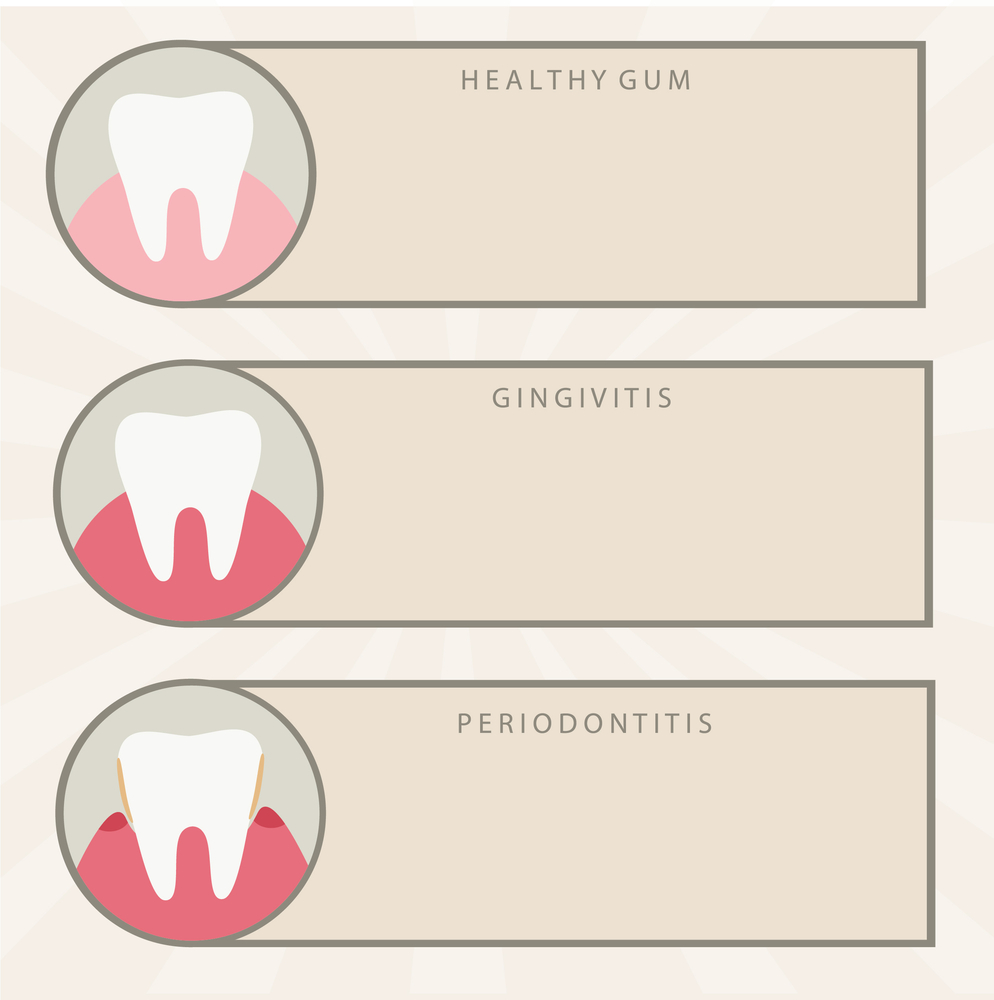
The disease is not accompanied by pain and this is why many patients fail to treat it on time. Gingivitis is treated by dental cleaning so that plaque can be removed from the surface of the teeth and from the gum line. With regular check-ups and dental cleaning performed twice per year we can effectively treat gingivitis, always in conjunction with good oral hygiene.
Unless gingivitis is treated on time, it gradually evolves into periodontal disease, which in turn develops into different stages, depending on the severity of the symptoms. Plaque along the gum line gradually hardens and turns into tartar which starts to deposit under the gum
line. The infection is no longer limited to soft tissues, i.e. gums, but it also affects hard tissues, i.e. the bone holding the tooth. Small spaces start to form between the tooth and the gum (periodontal pockets), which gradually become deeper and the tooth loses contact with the gum. Gingival recession increasingly develops, the bone gets damaged, there is tooth mobility until, eventually, teeth either fall or have to be extracted.
Periodontal disease can be treated conservatively with scaling and root debridement which
allow us to control the tissue infection. During scaling, we remove plaque and tartar under
the gum line, while with root debridement we clean and smooth the surface of the root, we
disinfect the periodontal pockets and we thus help the tooth reattach to the gums.
In the cases of a more advanced periodontal disease, the pockets deepen too much and
bacteria thrive in them, which renders cleaning them hard. In these cases, the disease can
be treated surgically, with elimination of the periodontal pockets. By lifting the gums, we
have better access to the root of the tooth and we can remove tartar more easily. At the
same time, we also clean the bone and, if necessary, we can shape it so as to facilitate
reattachment to the gums. The aim of this procedure is to reduce the depth of the
periodontal pockets. This deep cleaning can also be performed by virtue of an incision of the
gum (flap) which reveals the root.
In each stage of periodontal disease and after any type of treatment we may choose, it is
very important that we retain the therapeutic result by virtue of excellent oral hygiene and
regular check-ups.