
Fixed Prosthodontics include fixed restorations which aim to substitute for missing teeth or to protect a tooth which has sustained damage. These restorations significantly improve
oral aesthetics and functionality, while offering protection from more serious problems which could arise in the future.
A dental crown or dental cap is a cover that caps the tooth. We usually use crowns to cover a tooth that has undergone root canal treatment, or which has a large filling. This way we
can prevent the formation of cracks and fractures or protect teeth if such damages have already been sustained. Another case when we use crowns is in order to support a tooth with a large filling when there is not enough tooth left. Of course, crowns also contribute to a tooth’s aesthetic restoration.
Before the crown is placed, the tooth is filed down so that there is enough room for the crown and stability is ensured. Crowns are usually made of metal and porcelain, i.e. they have a metal frame which is covered by porcelain. But the best aesthetic results are achieved with crowns made entirely out of porcelain.
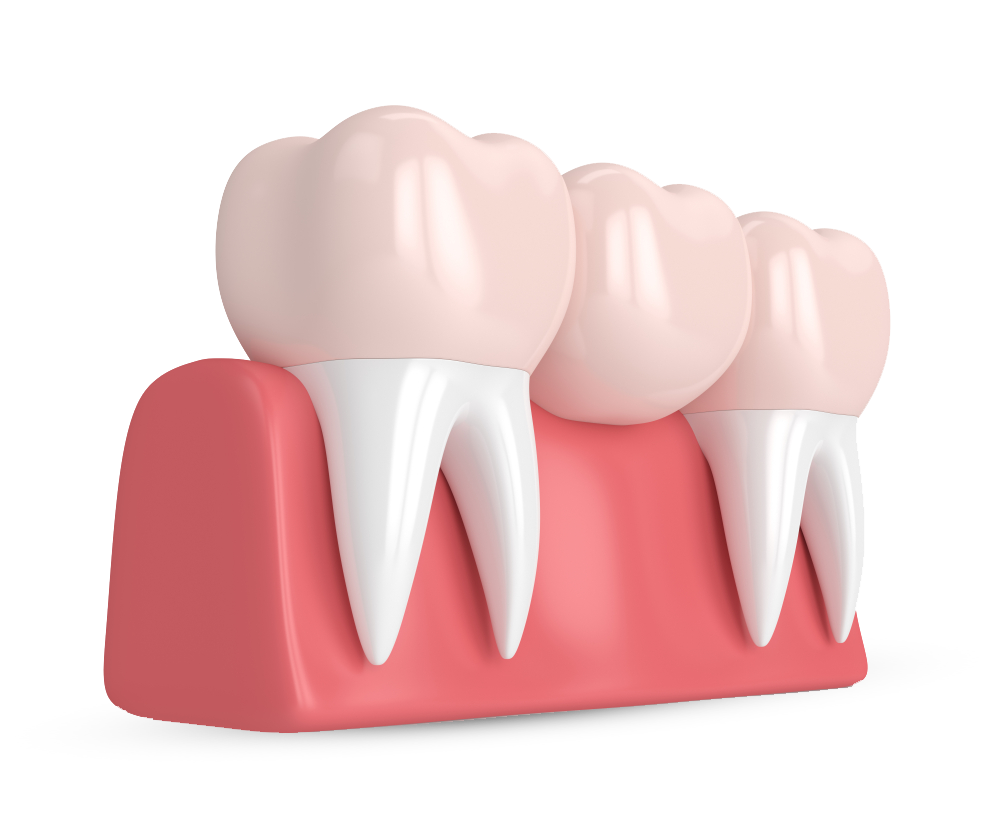
A bridge is a fixed restoration used to replace one or more missing teeth. For the placement of the bridge, the teeth on either side of the gap left by the missing tooth are used as supports. These anchoring teeth are filed down -just like in the case of crown placement- in
order for the restoration to fit on them. In between these teeth there is one or more false teeth which will serve to fill the gap.
A bridge is a very important procedure because it prevents a number of problems which may arise when even a single tooth is missing, such as drifting of the adjacent teeth out of position, dental caries, periodontal disease and bone resorption. With the loss of teeth, the forces in your bite are not evenly distributed and as a result the function of and the balance in your mouth is disturbed.
Bridges are made of various materials (full ceramic, porcelain-fused-to-metal) and have a long lifespan if you diligently follow oral hygiene rules. The anchoring teeth may develop dental caries, gingivitis or periodontal disease after the placement of the bridge, in which case the bridge must be removed.